Introduction
Cloud computing has become an important part of modern digital infrastructure. Instead of depending entirely on physical servers and on-premise infrastructure, businesses can access computing resources such as servers, storage, databases and software through the internet.
Cloud platforms provide flexible resources that can be adjusted as business requirements change. This makes cloud computing particularly useful for organizations that need to grow their applications and digital operations efficiently.
What is Cloud Computing?
Cloud computing is the delivery of computing services over the internet. These services can include computing power, storage, databases, networking, software, analytics and other technology resources.
Businesses can access these resources when required instead of maintaining all infrastructure on their own.
Benefits of Cloud Computing
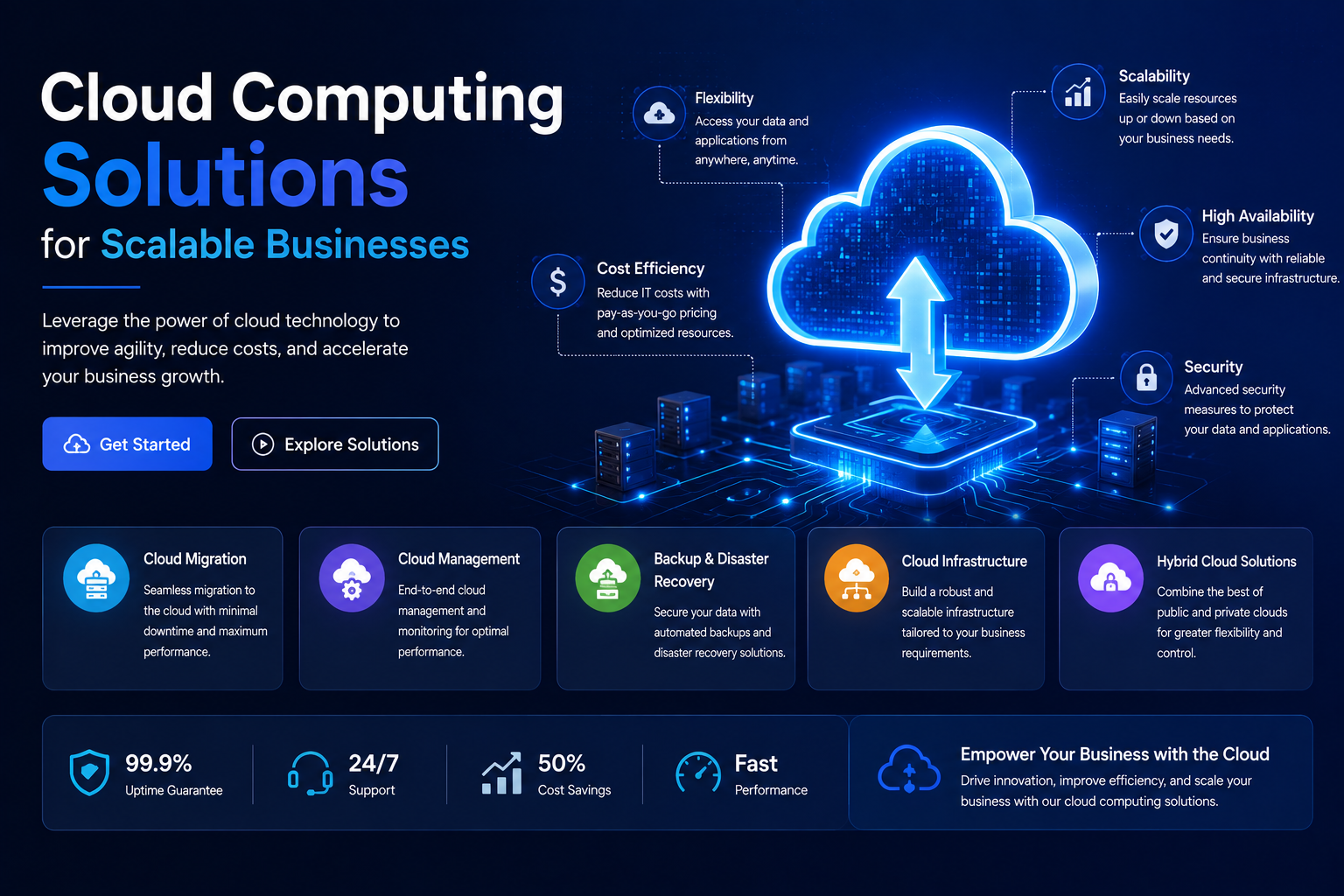
- Scalability: Increase or decrease resources according to business demand.
- Cost Efficiency: Reduce the need for large upfront infrastructure investments.
- Flexibility: Access applications and resources from different locations.
- Performance: Provide resources required for demanding workloads.
- Reliability: Support backup, redundancy and business continuity strategies.
- Faster Deployment: Provision computing resources much faster than traditional infrastructure.
Our Cloud Computing Solutions
1. Cloud Migration
Move existing applications, databases and workloads from traditional infrastructure to suitable cloud environments.
2. Cloud Infrastructure
Design and configure cloud infrastructure according to application requirements, performance needs and business goals.
3. Cloud Application Development
Develop modern applications that can take advantage of cloud infrastructure and scalable architecture.
4. Cloud Storage Solutions
Implement flexible cloud storage solutions for business data, applications, backups and files.
5. Cloud Backup & Disaster Recovery
Create backup and recovery strategies that help businesses prepare for unexpected infrastructure failures.
Types of Cloud Computing
Public Cloud
Public cloud infrastructure is provided by cloud service providers and shared across customers while maintaining logical isolation.
Private Cloud
Private cloud environments are designed for dedicated organizational workloads and can provide greater control over infrastructure.
Hybrid Cloud
Hybrid cloud combines private infrastructure with public cloud resources to support different business and workload requirements.
Multi-Cloud
Multi-cloud strategies use services from multiple cloud providers to support different workloads and business requirements.
Cloud Service Models
Infrastructure as a Service — IaaS
IaaS provides computing infrastructure such as virtual machines, storage and networking resources.
Platform as a Service — PaaS
PaaS provides development and deployment environments that help developers build and deploy applications without managing every underlying infrastructure component.
Software as a Service — SaaS
SaaS provides ready-to-use software applications through the internet.
Serverless Computing
Serverless architectures allow developers to focus on application functionality while the cloud platform manages much of the underlying infrastructure.
Cloud Scalability
Cloud scalability allows organizations to adjust resources according to application demand. When traffic increases, additional computing resources can be provisioned. When demand decreases, resources can be reduced.
This approach helps businesses maintain application performance while avoiding unnecessary infrastructure capacity.
Cloud Security
Security is an important part of any cloud environment. Cloud security strategies can include identity management, access control, encryption, monitoring, backups and security policies.
- Identity & Access Management
- Data Encryption
- Network Security
- Security Monitoring
- Backup Management
- Access Policies
Cloud Application Development
Modern applications can be designed with cloud-native principles to support scalability, reliability and efficient deployment.
- Responsive Web Applications
- REST APIs
- Microservices
- Containerized Applications
- Database Integration
- Automated Deployment
Our Cloud Migration Process
1. Assessment
Analyze existing infrastructure, applications, databases and business requirements.
2. Migration Planning
Create a migration roadmap based on workload dependencies, security, performance and business priorities.
3. Architecture Design
Design a suitable cloud architecture for applications and workloads.
4. Migration
Move selected applications, data and workloads to the target cloud environment.
5. Testing
Test functionality, performance, security and availability after migration.
6. Optimization
Optimize resources, performance, monitoring and cloud costs.
Cloud Technologies
Modern cloud environments can use different platforms and technologies depending on application requirements.
- Microsoft Azure
- Amazon Web Services
- Google Cloud
- Docker
- Kubernetes
- Cloud Databases
- Serverless Platforms
- Cloud Monitoring
Cloud Computing Use Cases
- Business Website Hosting
- Web Application Hosting
- E-Commerce Platforms
- Database Hosting
- Data Backup
- Disaster Recovery
- Business Analytics
- AI and Machine Learning Workloads
- Remote Collaboration
- Application Development
Cloud Computing and Artificial Intelligence
Cloud platforms can provide scalable computing resources and managed services that support AI, machine learning and data analytics workloads. This allows businesses to experiment with advanced technologies without necessarily maintaining all of the underlying infrastructure themselves.
Why Businesses Choose Cloud Computing
- Reduce infrastructure complexity
- Improve scalability
- Support remote access
- Improve deployment speed
- Support business continuity
- Improve infrastructure flexibility
- Support digital transformation
How Cloud Computing Supports Business Growth
A scalable cloud infrastructure can help businesses respond to changing workloads, launch digital services faster and support growing numbers of users.
Cloud environments also provide access to modern infrastructure and services that can help organizations experiment with new technologies and digital products.
Build a Scalable Future with Cloud Computing
Cloud computing provides businesses with flexible access to computing infrastructure, applications, storage and other technology services.
With the right architecture, security, migration strategy and monitoring, cloud technology can provide a strong foundation for modern digital businesses.
At Technoartz, we help businesses adopt cloud technologies according to their applications, workloads, security requirements and growth objectives.
Scale smarter. Move faster. Build for the cloud.